• contact@medicineandislam.org
Follow us on:

Exploring Bioscience and Islam

A Curriculum on Fundamental Questions about the Human Being

The goal of the Exploring Bioscience and Islam curriculum is to build conceptual literacy at the intersection of bioscience and theology among Muslim students and cultivate confidence in using wahy (revelation) as a genuine source of knowledge. Having a wahy-focused worldview, along with utilizing knowledge from the rational and empirical sources, will widen one’s horizon to address the fundamental questions about the human being. This curriculum is designed to tackle critical topics in biology and science that can cause confusion in the minds and hearts of Muslim students. By applying a holistic epistemological framework, educators can help students gain clarity and extend these concepts to our quickly changing and advancing world.

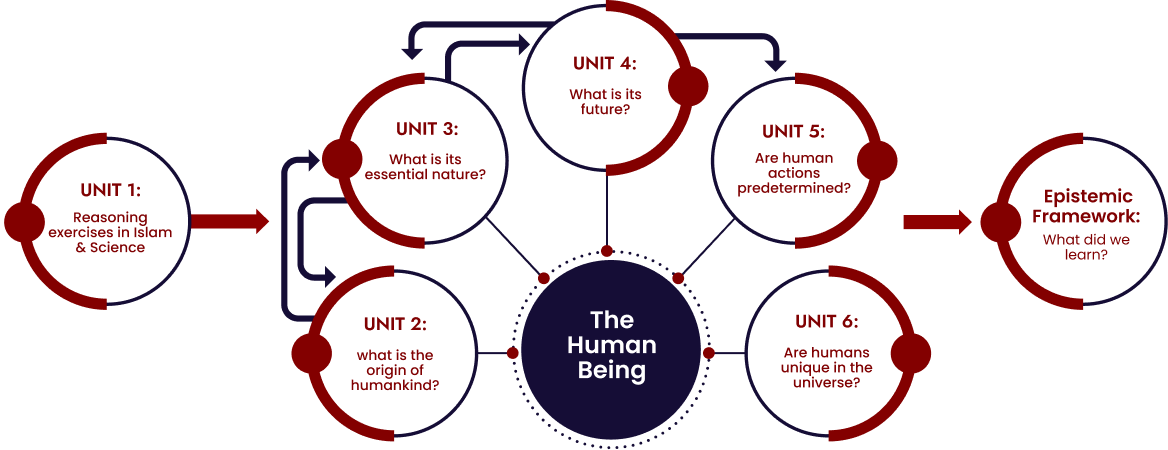
Five Fundamental Questions about the Human being:

What is the origin 
of humankind?

What is the human’s essential nature?

What is the human’s future?

Are human actions predetermined?

Are humans unique in the universe?

Epistemological Framework

Overarching Goals

What should the students gain and which skills should be built:
  • Obtain an understanding that knowledge, both religious and scientific, is not always conclusive rather it must be evaluated in terms of the evidence sources and the relative certainty that can be attached to them
  • Gain familiarity with epistemiology; i.e. that there are revelatory, rational, and empirical sources of knowledge and claims from each domain may overlap, complement, or even conflict with each other. One must critically evaluate how truth claims from each of these sources of knowledge relate to each other.
  • Recognize that the source of all knowledge is Allah [swt] and as such religious and scientific knowledge cannot conflict in reality. However humans are fallible so our understandings and interpretations are partial views into ultimate reality.
Relationships between the Units

UNIT Contents

Exercise & Application

What Do We Know and How Do We Know It? Reasoning Exercises in Islam and Science

What is the Origin of Mankind?
Evolution and God's Special Creation.

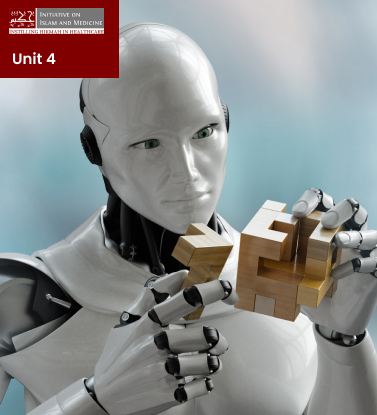
What does it mean to be a Human Being? Neuroscience, Artificial Intelligence and the Soul.

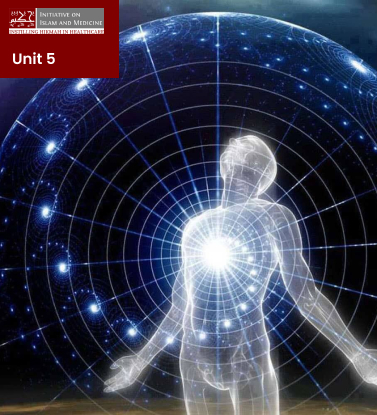
Human Enhancement and Transhumanism:
Are we changing and should we change our being?

Are We Programmed or Do We Have Free Will? Discussions on Fate and Genetic Determinism

Are Human Beings Unique in this Universe?
Science and Theological Inquiry about Extraterrestrial Life

Access the Curriculum Here – 

For Educators: Access the free Exploring Bioscience & Islam Curriculum, including lesson plans, presentations, worksheets, and classroom resources.

For Individual Learners: Prefer a structured, self-paced learning experience? Enrol in the Exploring Bioscience & Islam online course on MuslimEdEx.

Sources of Knowledge

One acquires knowledge from three sources: empirical, rational, and revelatory. A construct that applies to all these sources of knowledge is whether the knowledge is qati (conclusive) or zanni (probabilistic).

The criteria by which one determines certainty or uncertainty varies depending on the source of knowledge, which is exemplified in this curriculum.Within each Unit’s materials, there is a Spectrum of Certainty diagram that is recommended to have on display for students to serve as a reminder to contemplate the truth value of all knowledge types

Thought-provoking Questions

In order to guide and provoke thought, students should be asked to keep in mind the following concepts and contemplate them as the lessons are covered:

Challenge students to think about the differences between Muslim and non-Muslim scientists.

→ What sources of knowledge would each access?

→ What intentions would each have? And why? (What motivates their inquiry?)

Reflect on the differences between Muslim scientists and Muslim theologians. Is there a difference between these two and should there be a distinction between these two?

Key
Features

Each lesson in the Exploring Bio-Science and Islam Curriculum is designed to support teachers and students through the learning process by providing instruction before, during, and after learning.

A Triple-Entry Vocabulary Journal template is provided to encourage multiple interactions between students and the topics and facilitate connections between the material. Instructing students to keep a vocabulary journal for these lessons will help students to recollect and comprehend the demanding vocabulary with ease.

Supplemental and Resource Materials are provided for teachers to educate themselves and be effective in teaching this intricate and challenging material to students.

This curriculum utilizes the Gradual Release of Responsibility (GRR) model to incorporate explicit instruction, modeling, guided practice, and independent practice into its lessons.

How These Lessons can be Utilized in the Classroom:

  • Use lessons for in-classroom course teaching.
  • Use lessons as part of a flipped classroom model where videos and materials are viewed by students first and then discussed in the classroom.
  • Use lessons as an Islamic supplement to standard biology courses.
  • Use lessons as a supplemental topic within Islamic studies classes.

How These Lessons can be Utilized in Extra-Curricular Settings:

  • Use lessons as materials for Islamic circles.
  • Use lessons as a course for the Islamic Scholars (Ulemaa).
  • Use lessons as a focused course in a Masjid or Muslim Students Association (MSA) setting.
  • Use lessons in Weekend/Sunday Schools.
  • Use lessons as Summer Elective Courses.
  • Use lessons for Independent Study.

Testimonials

The opinions expressed in this publication are those of the authors. They do not reflect the opinions or views of the funding organization.

FAQs

If you are an educator seeking lesson plans, presentations, worksheets, and classroom resources, visit our Exploring Bioscience & Islam Curriculum page.

The online course is designed for individual learners who wish to study the material in a structured, self-paced format – Exploring Bioscience & Islam online course on MuslimEdEx.

Absolutely, our curriculum is versatile and adaptable for homeschooling setups, alongside its use in weekend schools, full-time Islamic schools, and with youth groups.

While prior experience in teaching Islamic Studies is beneficial, our curriculum offers comprehensive guidance, making it accessible even to those with less experience. For seasoned educators, there’s room for modification and feedback sharing.

Our curriculum serves as a supplementary resource to existing Islamic Studies curricula, enriching the classroom experience with contemporary topics. You can integrate lesson plans into your schedule on a daily, weekly, or monthly basis, selecting units that align with your teaching objectives.

Each unit comprises 3-5 lesson plans, with each lesson designed for approximately 50-minute sessions. Lesson plans can be adjusted to accommodate students’ needs, either within the allotted time frame or extended for in-depth exploration.

All units feature clear learning objectives, readily available presentations, worksheets, and assessments to facilitate a comprehensive learning experience.

Initiative on Islam and Medicine © 2025 - All Rights Reserved. Designed and Powered By Digaptics

Access to the materials

Statement of Attribution

Here is one way to cite this website/project:

Initiative on Islam and Medicine. (2024). Fostering Connections between Bioscience and Theology for Medical Track Muslim Students. https://medicineandislam.org/fostering-connections-between-science-and-theology-2/