Support Our Mission to Empower Muslim Healthcare Professionals

The Prophet ﷺ said:
Whoever relieves a Muslim of some worldly distress, Allah will relieve him of some of the distress of the Day of Resurrection
II&M’s Mission:
Shaping Culturally & Religiously Accommodating Healthcare for Muslims
The Initiative on Islam & Medicine (II&M) fosters wisdom by equipping Muslim patients, clinicians, and imams with practical Islamic bioethics knowledge, developed through a multidisciplinary collaboration of fuqaha, ulama, healthcare professionals, and subject-matter experts
.Through research, education, and advocacy, we translate this knowledge into real-world impact—conducting national studies, shaping policy, and providing guidance through masjid workshops and academic conferences.
Our Impact
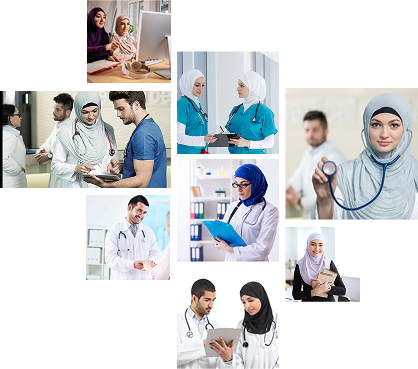
- Empowering Muslim healthcare professionals & chaplains with religious sensitive training.
- Partnering with colleges to provide Islamic bioethics guidance to chaplains through research, educational materials, and workshops.
- Providing guidance for patients & families navigating complex medical decisions through workshops and publications.
We are not just responding to challenges—we are shaping the future of healthcare for Muslim communities.
Empowering Muslim Communities
Our work strengthens the intersection of religion, healthcare, and policy to create lasting change.

Muslim Healthcare
Professionals
- Equipping doctors, students, and chaplains with religiously sensitive training.
- Researching challenges in discrimination, ethical dilemmas, and workplace bias.

Healthcare
Systems
- Shaping hospital policies that accommodate Muslim patient needs (prayer spaces, fasting guidelines, end-of-life care).
- Training healthcare leaders to provide religiously-sensitive care.
Academic & Public
Discourses
- Conducting national research studies on Islam & medicine.
- Developing bioethics courses for universities, hospitals, and policymakers.

Muslim
Communities
- Hosting masjid workshops to educate imams & families about healthcare rights.
- Advocating for inclusive medical spaces where religion is honored.
A Doctor’s Reflection
The Need for religiously sensitive Healthcare
As a medical student, It should be I remember visiting Muslim patients in our hospital. Recognizing that such visitation was a fard kifaya (a communal obligation), I naively thought that spreading smiles and reading Qur’an would be enough. But I was unprepared for the deep struggles many Muslim patients faced—questions of religion, suffering, and the meaning of their final moments.
One patient has never left my mind—a young African American man with terminal cancer. Islam had never been a major part of his life; he did not grow up in a Muslim household. Yet, as his condition worsened, he asked me a question that shook me:
"Is God punishing me?"

But his final request was even more profound:
“Teach me how to pray as a Muslim. Show me how to die as a Muslim.”
In that moment, I realized how unprepared we are—as medical professionals, as a community—to provide religiously appropriate, compassionate end-of-life care. Muslim patients should not have to search for guidance in their final moments. They deserve trained professionals who understand their needs, their struggles, and their religion.
This is why our work at II&M is essential. This is why we must act.
A Decade of Impact

- Replication Guides: Standardized frameworks to ensure consistency in research
- Teaching Modules: Educational resources for training healthcare professionals and researchers
- Survey Measures: Validated tools to capture the healthcare experiences of Muslim communities.
- Decision Aids: Guiding patients and providers in making informed, faith-conscious healthcare decisions.

- Mammography Screening
- Islamic Bioethics
- End-of-Life Care Ethics
- Organ Donation Ethics
- Muslim Health Research

- Muslim American Healthcare & Spiritual Needs (MAHSN)
- Fostering Science & Theology Connections for Muslim Students
- Cancer Screening Among Chicagoland Muslim Women
- Religiously-Tailored Mammography Intervention for American Muslims
- National Survey of Muslim Physician Attitudes towards Religion and Medicine
- Discrimination, Accommodation & Inclusion: Examining Muslim Clinician Experiences within Academic Medicine
- Advancing Equity for Muslim Physicians in the Healthcare Workforce

- Constructing the Field of “Islamic” Bioethics: An Intensive Reading Course
- A Mentored Introduction to Islam and Bioethics
- Islam, Medical Ethics, and Spiritual Care
- Introduction to the Field of Islamic Bioethics Course
II&M's Development
Pyramid
-
Advanced Research Collective on Islam &
Biomedicine

Publication: Maqasid Al-Shariah and Biomedicine: Bridging Moral, Ethical, and Policy Discourses.
- Islamic Bioethics Workshops & Intensives
Development of New Educational Resources
- Dedicated Program Manager for Research & Implementation
Sustained Intellectual & Moral Support Network Strengthening Institutional Frameworks
- Volunteer Engagement & Participation